The Lab Partners Team Blog Join Pursuit
← From the Lab

We Are Incredibly Early.

And Already at an Existential Moment.

The vast majority of humanity still has not meaningfully used AI. And yet the implications already feel existential.

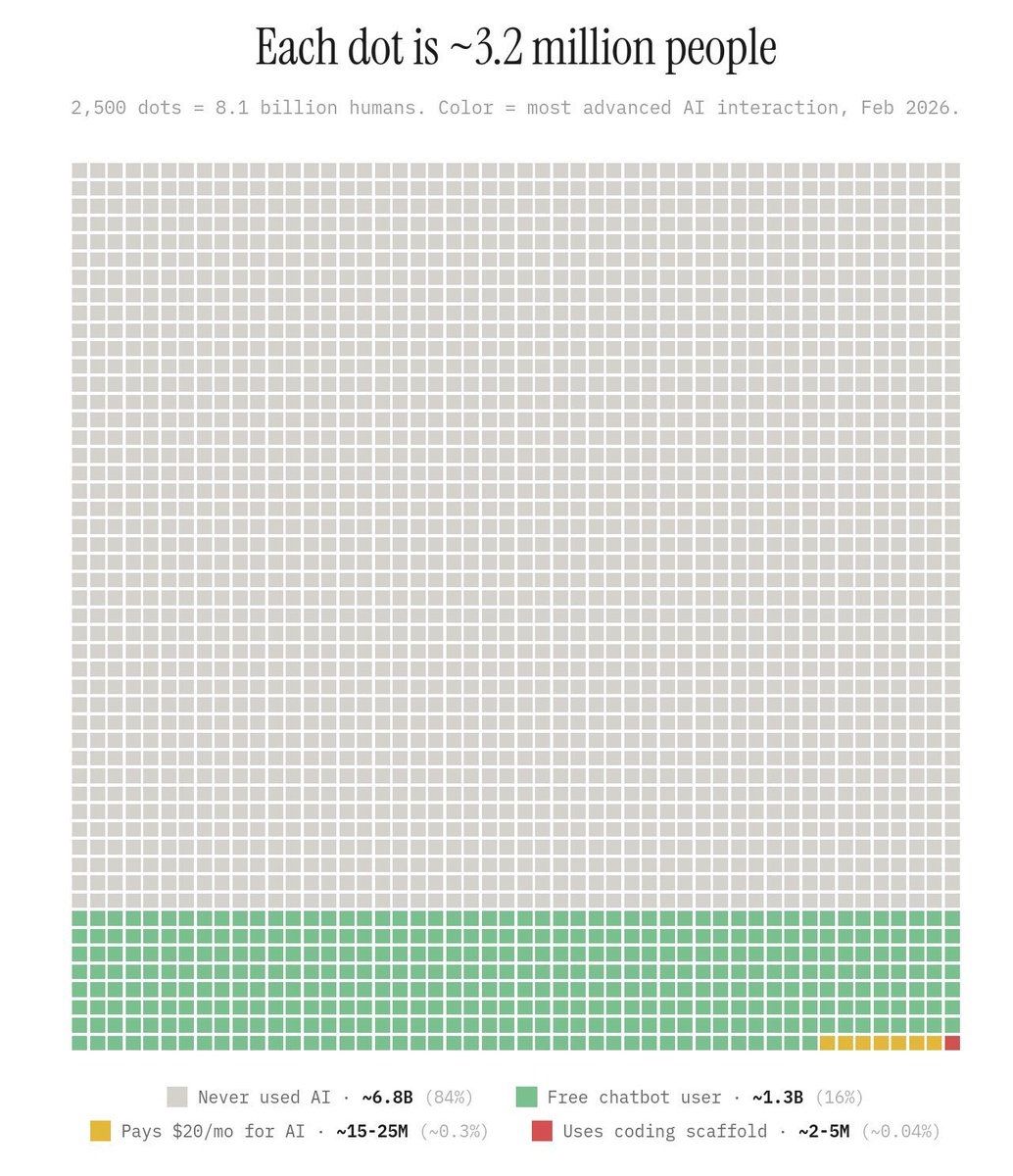
Each dot is ~3.2 million people. 2,500 dots = 8.1 billion humans. Color = most advanced AI interaction, Feb 2026.

Each dot is ~3.2 million people. Source: approximations, Feb 2026

Look at the image above for a second. If its approximations are even roughly right, the message is startling. The vast majority of humanity still has not meaningfully used AI. A smaller group is using free chatbots. A tiny sliver is paying for AI. And an almost microscopic number of people are using AI for coding scaffolds and more advanced applied workflows.

That is the paradox of this moment. We are still extremely early in adoption, yet the implications already feel existential. The technology has arrived before society, companies, and institutions have properly absorbed what it means. In other words, the world is still near the beginning of the usage curve, while already standing inside the strategic consequences.

We are still near the beginning of the usage curve, while already standing inside the strategic consequences.

The technology has arrived before society, companies, and institutions have properly absorbed what it means.

What Makes This Moment Unusual

This is what makes the current moment so unusual. Normally, existential shifts feel obvious only once adoption is everywhere. With AI, the opposite is happening. Even at this early stage, the pressure is already visible in software, services, education, media, research, and knowledge work more broadly. Entire sectors are starting to realise that this is not just another tool layer. It is a new operating layer.

In software, the change is already tangible. Writing code, debugging, refactoring, scaffolding, agentic development environments, and AI-assisted product design are changing how work gets done. But software is only the first sector to feel it clearly because it is closest to the tools. The bigger story is what happens as these capabilities move into professional services, operations, finance, logistics, healthcare administration, education, and any environment where people spend their days moving information between systems, decisions, documents, and workflows.

Don't wait for the shift to overwhelm you. Position ahead of it.

The Infrastructure Is Maturing

We are not late. We are early enough that the infrastructure is still being built, the standards are still forming, and the winning operating models are still up for grabs.

And yet, despite being early, companies cannot afford to be casual. The surrounding infrastructure is maturing fast. Tool connectivity standards are improving. Orchestration frameworks are getting more usable. Memory and state layers are becoming more robust. Durable execution is making it easier to move from experiments to live workflows. The stack is becoming real enough to shift AI from pilot projects into production systems.

The Real Question

How will our company need to refactor as these tools become embedded in real operating workflows?

It touches product design, service delivery, headcount shape, margins, customer expectations, defensibility, and speed of execution.

The size of the current user base understates the size of the coming impact. Small numbers can still signal a very large wave when the capability curve is steep, the infrastructure is improving, and the cost of intelligence keeps falling. What looks niche today can become normal much faster than incumbents expect.

The real opportunity is not just in consumer adoption numbers today. It is in understanding the second-order effects. Which sectors are most exposed? Which workflows will be rebuilt first? Capital needs a route to the frontier not because the market is mature, but because it is still forming.

Do not confuse low current penetration with low future importance. The organisations that learn fastest now, while things are still fluid, will be in a far better position than those who wait for the shift to become obvious to everyone.

So the right response to this image is not hype, and it is not complacency. It is clarity. We are early enough that there is still time to learn, position, and build. But we are far enough in that the implications are already profound. That is what makes this moment so important.

This is what the first chapter of a major reset looks like.

That is what an existential early market looks like.